About

The Incubator

William Acree, Co-Director

"Inter- and transdisciplinary connections are increasingly central to what makes a world-leading research university. The Incubator supercharges these kinds of connections at WashU. We've had many success stories over the past few years, but one of the most exciting is interdisciplinary thinking becoming more embedded in daily activities across our university."

Michael Frachetti, Co-Director

"The promise of transdisciplinary research and education lies in its infinite mutability and range for discovery. Now more than ever, engaging with the world means getting comfortable with the unknown, and I believe that is the hallmark of those whose impact is felt beyond a single domain."

Our Mission & History

The mission of the Incubator for Transdisciplinary Futures is to inspire and support innovative transdisciplinary research to advance new discoveries and thinking — shaping a bold vision for the university of the future. We fund and provide ongoing support for cross-campus collaborations that invite novel ideas, encourage unprecedented learning opportunities, and generate solutions to some of the world's most critical issues.

In 2022, we funded nine multiyear project teams as well as five yearlong programmatic grants. These projects epitomize the Incubator's ideals of convergence, creativity, and community. You can learn more about our project teams HERE

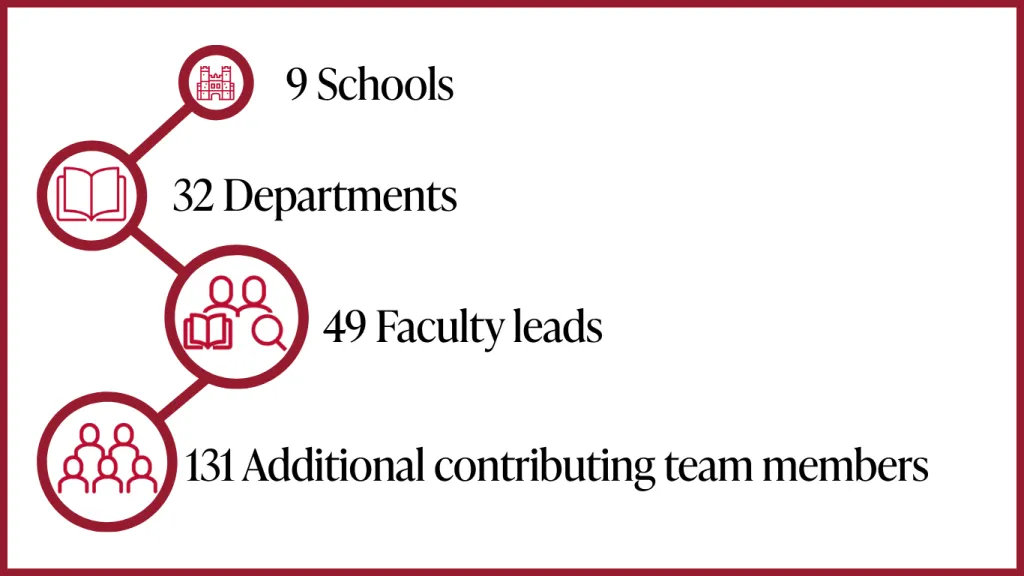
A look at the scale of cross-campus collaboration being enabled by the Incubator for Transdisciplinary Futures.

Police body-worn cameras are now in every major American city, but we still don't have a good sense of how they have or haven't changed policing. The Incubator pushed us to assemble a team that could think about the question from every angle, analyzing not just the data in body-worn camera footage but metadata about when cameras were and were not activated. This has enabled us to ask probing questions about how and why the actual use of these cameras differs from their expected use. It remains an exciting area of study because there's still so much we don't know. With support from the Incubator, our ongoing research can help us learn whether newer tools, such as algorithms trained to "watch" footage as it comes in, can augment the investment our society has made in this technology.

― Andrew Jordan Assistant Professor of Economics | Police Body Camera Metadata